Make the CPA review queue easier to act on
Define administrative readiness, separate missing inputs from technical questions, and preserve review history.
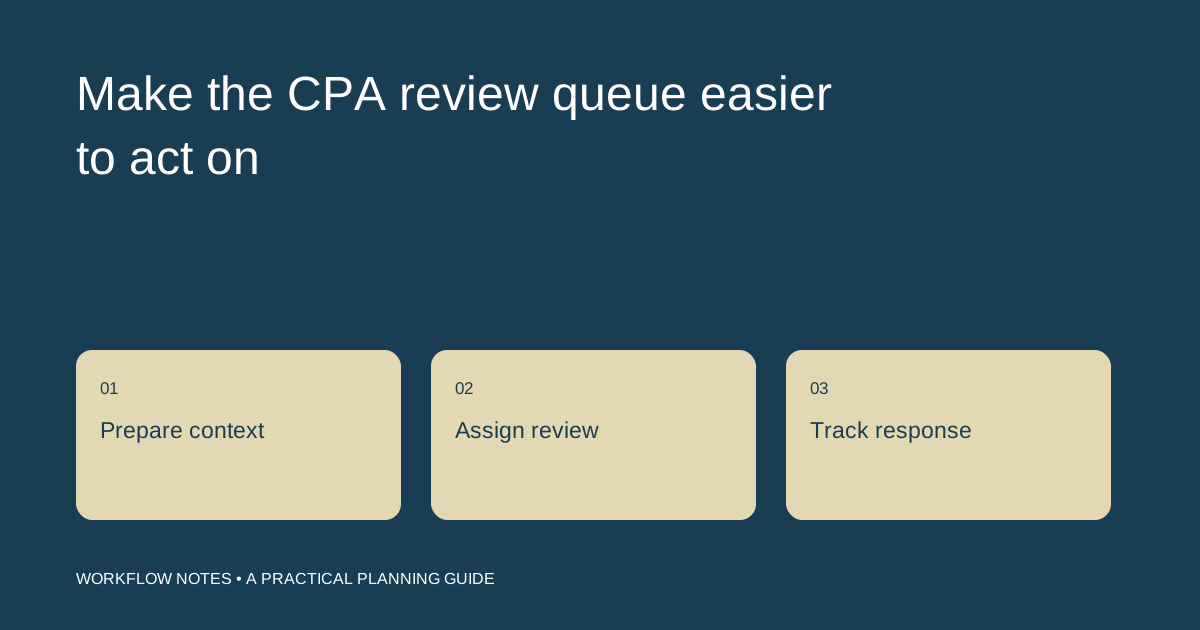
A review queue is useful only when the reviewer can tell what is ready, what is missing, and what decision is needed. During a busy period, “sent for review” can become a parking place for incomplete work. Administrative support can improve the queue’s visibility while the CPA retains professional judgment and sign-off.
The operating model below separates coordination from technical review. Adapt it to the engagement type, firm policies, and responsibilities established by the practice.
Define review readiness with the engagement owner
Ask the person responsible for review to define the administrative conditions for entering the queue. These might include the correct engagement reference, links to the approved work area, a completed request index, and a list of unresolved questions. They should not require an assistant to decide whether accounting conclusions are correct.
A readiness checklist is a routing aid. It is not a substitute for professional review and should not use wording that implies assurance beyond the assistant’s role.
Create a cover record that answers the next question
A reviewer opening an item should be able to see why it is in the queue and what response is expected. The assistant can maintain this cover record without editing the underlying professional work.
| Field | Useful content |
|---|---|
| Engagement reference | The firm’s stable identifier |
| Review stage | The specific queue or review level |
| Assigned reviewer | Named owner and approved backup |
| Materials location | Link to the controlled work area |
| Open questions | Questions supplied by the preparer or engagement team |
| Next milestone | Date set by the engagement owner |
Avoid duplicating sensitive client information in a broadly accessible dashboard. A reference and an appropriate link can provide visibility without creating a second client file.
Separate missing inputs from review questions
A missing upload and an unresolved technical question need different owners. If both appear as “pending,” the queue cannot explain what is blocking progress. Use distinct categories and route each according to the firm’s instructions.
Consider an illustrative engagement with a missing client response and a preparer’s question for the manager. The coordinator can chase the approved client request and place the technical question in the manager’s queue. The coordinator should not answer the technical question to make the engagement appear ready.
Track return trips through the queue
Review often produces follow-up work. Preserve the reviewer’s instruction, identify the person responsible for the response, and record when the item returns. A new version should not erase the history of the previous review round.
When the review instruction is unclear, ask the designated owner to clarify it. Paraphrasing a technical comment into an apparently simpler task can change its meaning. Administrative notes should point to the authoritative instruction rather than replace it.
Plan coverage before the queue becomes urgent
The practice should establish who can reassign an item, how absences are handled, and which milestones require escalation. An assistant can surface the conflict and arrange an approved reassignment. The authority to prioritize or sign off remains with the firm.
A daily exception view might show unassigned items, items awaiting a named response, and work approaching the owner’s review date. Avoid reporting every old item as late without considering the agreed timetable and current dependency.
Choose measures that reveal friction
Count items with missing owners, incomplete routing information, or unresolved handoffs. Review the time spent in each administrative stage only when the underlying timestamps are reliable. A total age figure can be misleading if it combines client waiting time, preparation, and professional review.
Pair the numbers with a small record sample. Can the reviewer locate the current materials? Does the queue show the latest instruction? Is an item marked closed only after the authorized decision? Those questions test whether the system supports the work.
Our review queue coordination and CPA client coordination services can be defined around these responsibilities. Bring a sample queue structure and your review ownership rules to a free consultation; avoid sharing live confidential client records through the public form.